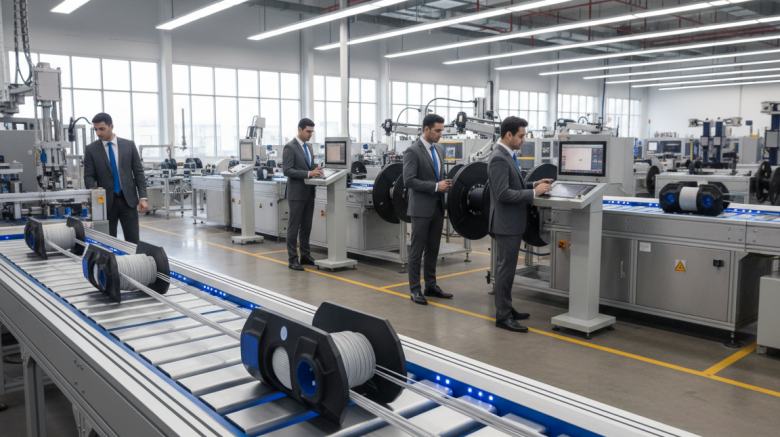
More than 60% of recent broadband deployments in urban U.S. projects now specify fiber-to-the-home. That fast transition toward full-fiber networks underscores the immediate need for high-performance production equipment.
SZ Stranding Line

Fiber Draw Tower

Fiber Ribbone Line
Shanghai Weiye Optic Fiber Communication Equipment Co (www.weiye-ofc.com) delivers automated FTTH cable production line systems for the United States market. Their turnkey FTTH Cable Production Line for High-Speed Fiber Optics integrates machines and control systems. It turns out drop cables, indoor/outdoor cables, and high-density units for telecom, data centers, and LANs.
That high-performance FTTH cable making machinery delivers measurable business value. This line offers higher throughput together with consistent optical performance with low attenuation. This system further meets IEC 60794 as well as ITU-T G.652D / G.657 standards. Customers gain reduced labor costs as well as material waste through automation. Full delivery services include installation together with operator training.
The FTTH cable production line package includes fiber draw tower integration, a fiber secondary coating line, and a fiber coloring machine. It also adds SZ stranding line, fiber ribbone line, compact fiber unit assembly, cable sheathing line, armoring modules, and testing stations. Control and power specs commonly use Siemens PLC with HMI, operating at 380 V AC ±10% and modular power consumption up to roughly 55 kW depending on configuration.
Shanghai Weiye’s customer support model provides on-site commissioning by experienced engineers, remote monitoring, and rapid troubleshooting. It also offers lifetime technical support and operator training. Clients are typically required to coordinate engineer logistics as part of standard supplier practice when ordering from FTTH cable machine suppliers.
Main Takeaways
- FTTH cable production line solutions meet growing U.S. demand for fiber-to-the-home deployments.
- Turnkey systems from Shanghai Weiye combine automation, standards compliance, and operator training.
- Modular configurations use Siemens PLC + HMI and operate near 380 V AC with up to ~55 kW power profiles.
- Combined production modules cover drawing, coating, coloring, stranding, ribbon, sheathing, armoring, and testing.
- Advanced FTTH cable making machinery reduces labor, waste, and improves optical consistency.
- Support includes on-site commissioning, remote diagnostics, and lifetime technical assistance.
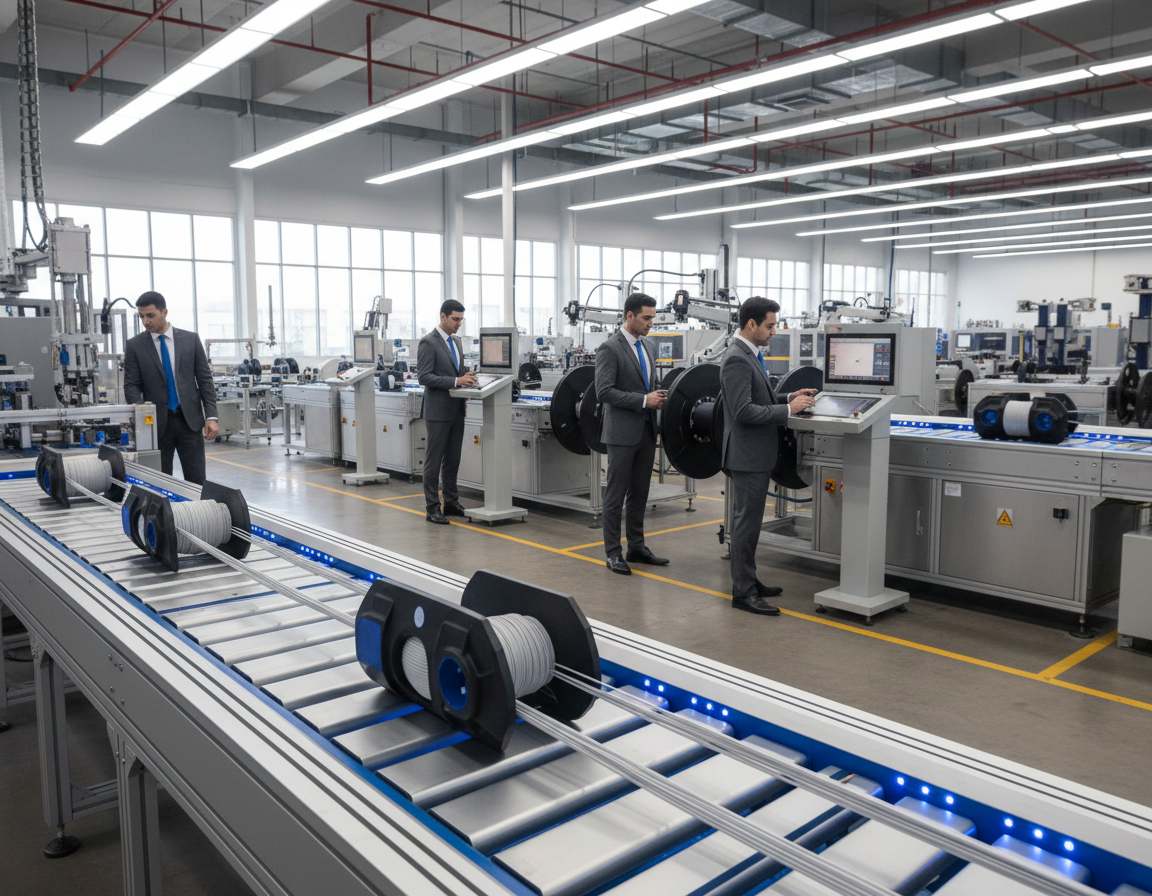
FTTH Cable Production Line Technology Explained
This fiber optic cable line output process for FTTH demands precise control at every stage. Producers employ integrated lines that combine drawing, coating, stranding, together with sheathing. This approach boosts yield as well as speeds up market entry. This system meets the needs of both residential and enterprise deployments in the United States.
Below, we review the core components and technologies driving modern manufacturing. Each module must operate with precise timing and reliable feedback. The choice of equipment shapes product quality, cost, and flexibility for various cable designs.
Modern Fiber Optic Cable Manufacturing Components
Secondary coating lines apply dual-layer coatings, often 250 µm, using high-output UV curing. Tight buffering as well as extrusion systems deliver 600–900 µm jackets for indoor as well as drop cables.
SZ stranding lines rely on servo-controlled pay-off as well as take-up units to handle up to 24 fibers using accurate lay length. Fiber coloring machines employ multi-channel UV curing to mark fibers to industry color codes.
Sheathing and extrusion stations produce PE, PVC, or LSZH jackets. Armoring units add steel tape or wire for outdoor protection. Cooling troughs and UV dryers stabilize profiles before testing.
Evolution From Traditional To Modern Production Systems
Early plants used manual and semi-automatic modules. Lines were separate, with hand transfers and basic controls. Modern facilities shift toward PLC-controlled, synchronized systems with touchscreen HMIs.
Remote diagnostics and modular turnkey setups allow rapid changeover between simplex, duplex, ribbon, and armored formats. This shift supports automated fiber optic cable production and reduces labor dependence.
Key Technologies Driving Industry Innovation
High-precision tension control, based on servo pay-off and take-up, keeps geometry stable during high-speed runs. Multi-zone temperature control using Omron PID and precision heaters ensures consistent extrusion quality.
High-speed UV curing as well as water cooling accelerate profile stabilization while reducing energy use. Integrated inline testers measure attenuation, geometry, tensile strength, crush resistance, and aging data.
| Function | Typical Equipment | Advantage |
|---|---|---|
| Fiber draw process | Draw tower with automated tension feedback | Uniform core size and low attenuation |
| Fiber secondary coating | Dual-layer UV curing coaters | Uniform 250 µm coating for durability |
| Identification coloring | Multi-channel coloring machine | Precise identification for splicing and installation |
| Stranding | SZ stranding line, servo-controlled (up to 24 fibers) | Stable lay length for ribbon and loose tube designs |
| Sheathing & extrusion | Efficient extruders with multi-zone heaters | Precise jacket dimensions in PE, PVC, or LSZH |
| Protection armoring | Armoring units for steel tape or wire | Enhanced mechanical protection for outdoor use |
| Cooling & curing | Cooling troughs plus UV dryers | Quicker profile setting with fewer defects |
| Quality testing | Inline geometry and attenuation measurement | Immediate quality verification and compliance data |
Compliance with IEC 60794 and ITU-T G.652D/G.657 variants is standard. Manufacturers typically certify to ISO 9001, CE, and RoHS. These credentials help support diverse applications, from FTTH drop cable production to armored outdoor runs and data center high-density solutions.
Choosing cutting-edge fiber optic production equipment together with modern manufacturing equipment allows firms meet tight tolerances. That decision enables efficient automated fiber optic cable line output together with positions companies to deliver on scale and consistency.
Essential Equipment In Fiber Secondary Coating Line Operations
The secondary coating stage is critical, giving drawn optical fiber its final diameter and mechanical strength. It prepares the fiber for stranding and cabling. A well-tuned fiber secondary coating line controls coating thickness, adhesion, and surface quality. That protects the glass during handling.
Producers aiming for high-yield, high-speed fiber optic cable production must match material, tension, and curing systems to process requirements.
High-speed secondary coating processes rely on synchronized pay-off, coating heads, and UV ovens. Modern systems achieve high production rates while minimizing excess loss. Precise tension control at pay-off and winder stages prevents microbends and ensures consistent coating thickness across long runs.
Single and dual layer coating applications address different market needs. Single-layer setups provide basic mechanical protection and a simple optical fiber cable production machine footprint. Dual-layer lines combine a harder inner layer with a softer outer layer to improve microbend resistance and stripability. This is useful when fibers are prepared for connectorization.
Temperature control together with curing systems are critical to final fiber performance. Multi-zone heaters and Omron PID controllers guide screw/barrel extruders to stable melt flow for LSZH or PVC compounds. UV curing ovens together with water trough cooling stabilize the coating profile and reduce variation in excess loss; targets for high-output quality single-mode fiber often aim for ≤0.2 dB/km at 1550 nm after extrusion.
Key components from trusted suppliers improve uptime as well as precision in an optical fiber cable line output machine. Extruders such as 50×25 models, screws as well as barrels from Jinhu, together with bearings from NSK are common. Motors from Dongguan Motor, inverters by Shenzhen Inovance, together with PLC/HMI platforms from Siemens or Omron deliver robust control and monitoring for continuous runs.
Operational parameters shape preventive maintenance and process tuning. Typical pay-off tension ranges from 0.4 to 1.5 N for fiber reels, while radiation and curing speeds are adjusted to material type and coating thickness. A preventive maintenance cycle around six months keeps secondary coating processes stable and supports reliable high-speed fiber optic cable production.
Fiber Draw Tower And Optical Preform Handling
The fiber draw tower is the core of optical fiber drawing. It softens a glass preform in a multi-zone furnace. Then, it pulls a continuous strand with precise diameter control. That stage sets the refractive-index profile and attenuation targets for downstream processes.
Process control on the tower relies on real-time diameter feedback together with tension management. This system helps prevent microbends. Cooling zones as well as closed-loop systems keep geometry stable during the optical fiber cable manufacturing process. Advanced towers log metrics for traceability and rapid troubleshooting.
Output quality supports single-mode fibers such as ITU-T G.652D and bend-insensitive types like G.657A1/A2 for FTTH networks. Draws routinely meet stringent loss figures. Excess loss after coating is kept at or below 0.2 dB/km for high-performance single-mode fiber.
Integration with secondary coating lines requires careful pay-off control. A synchronized handoff preserves alignment and tension as the fiber enters coating, coloring, or ribbon count stations. This link ensures the optical fiber drawing step feeds smoothly into cable assembly.
Equipment vendors such as Shanghai Weiye offer turnkey options. These include testing stations for attenuation, tensile strength, together with geometric tolerances. Such capabilities help manufacturers scale toward high-speed fiber optic cable manufacturing while maintaining ISO-level consistency checks.
| System Feature | Function | Typical Target |
|---|---|---|
| Multi-zone heating furnace | Uniform preform heating for stable glass viscosity | Uniform draw speed with controlled refractive profile |
| Real-time diameter control | Preserve core/cladding geometry and lower attenuation | Diameter tolerance of ±0.5 μm |
| Cooling and tension control | Reduce microbends and maintain fiber strength | Defined tension by fiber type |
| Integrated automated pay-off | Secure handoff to secondary coating and coloring | Synchronized feed rates for zero-slip transfer |
| On-line test stations | Validate attenuation, tensile strength, geometry | ≤0.2 dB/km loss after coating for single-mode |
Advanced SZ Stranding Technology For Cable Assembly
The SZ stranding method creates alternating-direction lays that cut axial stiffness and boost flexibility. This makes it ideal for drop cables, building drop assemblies, and any application that needs a flexible core. Manufacturers moving toward automated fiber optic cable manufacturing use SZ approaches to meet tight bend and axial tolerance specs.
Precision in the stranding stage protects optical performance. Modern precision stranding equipment uses servo-driven carriers, rotors, and modular pay-off racks that accept up to 24 fibers. These systems deliver precise lay-length control and allow quick reconfiguration for different cable types.
Automated tension control systems keep fibers within safe limits from pay-off to take-up. Servo pay-offs, capstans, and haul-off units maintain constant linear speed as well as target tensions. Typical fiber pay-off tension ranges from 0.4 to 1.5 N while reinforcement pay-offs run between 5 and 20 N.
Integration with a downstream fiber cable sheathing line streamlines production as well as reduces handling. Extrusion of PE, PVC, or LSZH jackets at 60–150 m/min syncs with stranding through a Siemens PLC. Cooling troughs and UV dryers stabilize the jacket profile right after extrusion to prevent ovality together with reduce mechanical stress.
Optional reinforcement and armoring modules add strength without compromising flexibility. Reinforcement pay-off racks accept steel wires or FRP rods. Armoring units wrap steel tape or wire with adjustable tension to meet specific mechanical ratings.
Built-in quality control prevents defects before cables leave the line. In-line geometry checks, fiber strain monitors, and optical attenuation measurement detect excess loss or mechanical strain caused by stranding or sheathing. These checks support continuous automated fiber optic cable manufacturing workflows and cut rework.
The combination of a robust sz stranding line, high-end precision stranding equipment, and a synchronized fiber cable sheathing line delivers a scalable solution for manufacturers. That blend raises throughput while protecting optical integrity and mechanical performance in finished cables.
Fiber Coloring And Identification System Technology
Coloring and identification are critical in fiber optic cable production. Accurate color application minimizes splicing errors and accelerates field work. Modern equipment combines fast coloring with inline inspection, ensuring high throughput and low defect rates.
Today’s high-output coloring technology supports multiple channels and quick curing. Machines can operate 8 to 12 color channels simultaneously, aligning featuring secondary coating lines. UV curing at speeds over 1500 m/min ensures color together with adhesion stability for both ribbon together with counted fibers.
Below, we discuss standards and coding prevalent in telecom networks.
Color coding adheres to international telecom standards for 12-color cycles and ribbon schemes. Such compliance aids technicians in installation and troubleshooting. Consistent coding significantly reduces field faults and accelerates network deployment.
Quality control integrates high-spec fiber identification systems into production lines. In-line cameras, spectrometers, together with sensors detect color discrepancies, poor saturation, and coating flaws. The PLC/HMI interface alerts to issues and can pause the line for correction, safeguarding downstream processes.
Machine specifications are vital for uninterrupted runs as well as material compatibility. Leading equipment accepts UV-curable pigments together with inks, compatible using common coatings together with extrusion steps. Pay-off reels accommodating 25 km or 50 km spools ensure continuous operation on high-volume lines.
Supplier support is essential for US manufacturers adopting these technologies. Shanghai Weiye and other established vendors offer customizable channels, remote diagnostics, and onsite training. This support reduces ramp-up time and enhances the reliability of fiber optic cable production equipment.
Fiber Solutions For Metal Tube Production
Metal tube and metal-armored cable assemblies provide robust protection for fiber lines. They are ideal for direct-buried and industrial applications. The controlled routing of coated fibers into metal tubes prevents microbends, ensuring optical performance remains within specifications.
Processes depend on precision filling and centering units. These modules, in conjunction with fiber optic cable manufacturing equipment, ensure concentric placement and controlled tension during insertion.
Armoring steps involve the use of steel tape or wire units with adjustable tension and wrapping geometry. This process benefits armored fiber cable production by preventing compression of fiber elements. It also keeps reinforcement wires at typical diameters of ø0.4–ø1.0 mm.
Coupling armoring with downstream sheathing and extrusion lines results in a finished outer jacket made of PE, PVC, or LSZH. An optical fiber cable production machine must handle pay-off reels sized for reinforcement and align with sheathing tolerances.
Quality checks include crush, tensile, together with aging tests to confirm the armor does not exceed allowable stress on fibers. Standards-based testing ensures long-term reliability in field conditions.
Turnkey solutions from established manufacturers integrate metal tube handling using SZ stranding as well as sheathing lines. These solutions include operator training as well as maintenance schedules to sustain throughput on fiber optic cable manufacturing equipment.
Buyers should consider compatibility using armored fiber cable production modules, ease of changeover, and service support for field upgrades. These factors reduce downtime as well as protect investment in an optical fiber cable manufacturing machine.
Fiber Ribbon And Compact Fiber Unit Manufacturing
Modern data networks require efficient assemblies that pack more fibers into less space. Manufacturers employ a fiber ribbon line to create flat ribbon assemblies for rapid splicing. That production method uses parallel processes and precise geometry to meet the needs of MPO trunking and backbone cabling.
Advanced equipment ensures accuracy and speed in production. A fiber ribbone line typically integrates automated alignment, epoxy bonding, precise curing, and shear/stacking modules. In-line attenuation and geometry testing reduce rework, maintaining high yields.
Compact fiber unit production focuses on tight tolerances and material choice. Extrusion and buffering create compact fiber unit constructions with typical tube diameters from 1.2 to 6.0 mm. Common materials include PBT, PP, and LSZH for durability and flame performance.
High-density cable solutions aim to enhance rack and tray efficiency in data centers. By increasing fiber count per unit area, these designs shrink cable diameter and simplify routing. They are compatible with MPO trunking and high-count backbone systems.
Production controls together with speeds are critical for throughput. Modern lines can reach up to 800 m/min, depending on configuration. PLC and HMI touch-screen control enable quick parameter changes together with synchronization across multiple lines.
Quality as well as customization remain key differentiators for manufacturers like Shanghai Weiye. Electronic monitoring, customizable ribbon counts, stacking patterns, as well as turnkey integration with sheathing as well as testing stations support bespoke fast-cycle fiber cable production line requirements.
| Feature | Fiber Ribbon Line | Compact Unit | Benefit for Data Centers |
|---|---|---|---|
| Typical Speed | Up to roughly 800 m/min | Typically up to 600–800 m/min | Greater throughput for large-scale deployments |
| Core processes | Automated alignment, epoxy bonding, curing | Buffering, extrusion, and precision winding | Stable geometry and reduced insertion loss |
| Primary materials | Engineered tapes and bonding resins | PBT, PP, LSZH jackets and buffers | Long service life with compliance benefits |
| Quality testing | In-line attenuation and geometry checks | Precision dimensional control with tension monitoring | Lower failure rates and faster rollout |
| Line integration | Integrated sheathing with splice-ready stacking | Modular units supporting high-density cable designs | Streamlined MPO trunking and backbone builds |
Optimizing High-Speed Internet Cable Production
Efficient high-output fiber optic cable line output relies on precise line setup and strict process control. To meet US market demands, manufacturers must adjust pay-off reels, extrusion dies, together with tension systems. That helps ensure optimal output for flat, round, simplex, and duplex FTTH profiles.
Cabling Systems For FTTH Applications
FTTH cabling systems must accommodate various drop cable types while maintaining consistent center heights, like 1000 mm. Production lines for FTTH include 2- and 4-reel pay-off options. They also feature reinforcement pay-off heads for enhanced strength.
Extruder models, such as a 50×25, control jacket speeds between 100 and 150 m/min, depending on LSZH or PVC. Extrusion dies for 2.0×3.0 mm profiles guarantee reliable jackets for field installation.
Quality Assurance In The Fiber Pulling Process
Servo-controlled pay-off and take-up units regulate fiber tension between 0.4–1.5 N to prevent excess loss. Inline systems conduct fiber pull testing, attenuation checks, mechanical tensile tests, as well as crush and aging cycles. Such tests verify performance.
Key control components include Siemens PLCs and Omron PID controllers. Motors from Dongguan Motor and inverters from Shenzhen Inovance ensure stable operation and easier maintenance.
How Optical Fiber Drawing Meets Industry Standards
A well-tuned fiber draw tower produces fibers that meet ITU-T G.652D and G.657 standards. The goal is to achieve ≤0.2 dB/km excess loss at 1550 nm for high-quality single-mode fiber.
Choosing the best equipment for FTTH cables involves evaluating speed, customization, warranty, and local after-sales support. Top FTTH cable manufacturing line manufacturers offer turnkey layouts, remote monitoring, together with operator training. That cuts ramp-up time for US customers.
Final Thoughts
Advanced FTTH cable making machinery integrates various components. These include fiber draw towers, secondary coating, coloring lines, SZ stranding, and ribbon units. It also includes sheathing, armoring, and automated testing for consistent high-speed fiber production. A complete fiber optic cable production line is designed for FTTH and data center markets. It enhances throughput, keeps losses low, and maintains tight tolerances.
For U.S. manufacturers and system integrators, partnering with reputable suppliers is key. They should offer turnkey systems with Siemens or Omron-based controls. This includes on-site commissioning, remote diagnostics, and lifetime technical support. Companies like Shanghai Weiye Optic Fiber Communication Equipment Co provide integrated solutions. These systems simplify automated fiber optic cable manufacturing and reduce time to production.
Technically, ensure line configurations adhere to IEC 60794 together with ITU-T G.652D/G.657 standards. Verify tension and curing settings to meet excess loss targets, such as ≤0.2 dB/km at 1550 nm. Adopt preventive maintenance cycles of roughly six months for reliable 24/7 operation. When planning a new FTTH cable manufacturing line, first evaluate required cable types. Collect product drawings together with standards, request detailed equipment specs and turnkey proposals, together with schedule engineer commissioning as well as operator training.